Sunday, March 28, 2010
Bhandasar Jain Temple
Wednesday, March 24, 2010
Headed West
Karni Mata - The Rat Temple
You need to be seated because you just won’t believe what you are about to read about and see. We all agreed that this is absolutely the craziest thing we have ever seen and been standing in the middle of. Just TRY to wrap your head around this one!
Front of The Rat Temple
Our last stop today will be at the Karni Mata Hindu Temple, also known as the Rat Temple. The temple is located a short 30km drive south from Bikaner in the small town of Deshnok.
The legend of Karni Mata goes like this –
In the 14th century, Goddess Karni is said to have lived and performed many miracles during her existence (she was a real person). Karni Mata was a mystic, who led a virtuous life committed to the service of the poor and the oppressed of all communities. The goddess is said to have laid the foundation of Deshnok. As per the stories, once when her youngest son drowned, Goddess Karni asked Yama (the god of death) to bring him back to life. Lord Yama replied that he could not return her son’s life. Thus, Karni Mata, being an incarnation of Goddess Durga (the invincible one, one who can redeem in situations of utmost distress), restored the life of her son. At this point of time, she announced that her family members would die no longer; in fact, they would incarnate in the form of rats (kabas) and ultimately, these rats would come back as members of her family. In Deshnok, there are around 600 families that assert to be the descendants of Karni Mata.
The temple at Deshnok was built in the 15th century. It houses around 5,000 rats that are fed, protected and worshipped. Many holes can be seen in the courtyard of this temple. In the vicinity of these holes, one can see rats engaged in different activities. The rats can be seen here eating from huge metal bowls of milk, sweets and grains. To make the holy rats safe, wires and grills are sited over the courtyard to avoid the birds of prey and other animals getting inside.
It is regarded as good luck if a rat runs over your foot (this happened to me twice!) and it is considered promising and fruitful if you spot a rare white rat. As with all Hindu temples, visitors must remove their shoes before entering, which could make you cringe if you are nervous about walking around with a bunch of rats at your feet. The temple floor is not filthy, but you do run the risk of stepping on a few droppings as you walk around the temple.
Here are the photos and movies……….
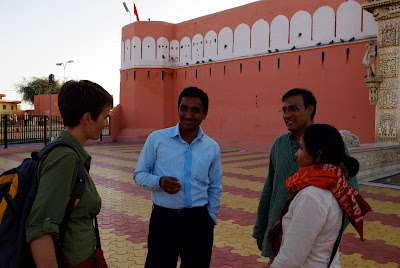
Here we are with our driver, Krpal, just outside the temple gates. He is giving us the history of the temple and trying to prepare us for what we are about to see.
Once inside the courtyard of the temple, we found these rats drinking from a bowl of milk.
You have to admit they are pretty cute.
Hey mom, you know I've done some pretty crazy things in my life, right? After seeing this, maybe now you won't think that bunji jumping in New Zealand was really that crazy after all!
Camels – The Ship of the Desert

NRCC Camel Breeding Farm
The desert dwellers of Rajasthan could not survive without their camels. In the sandy, inhospitable expanse of the Thar Desert, it is their only means of transport, their beast of burden, as well as an important source of nourishment (camels' milk, slightly salty in taste, is drunk throughout Rajasthan's desert). The hardy camel demands little in return. It can do without food and water for up to a month in winter, and a week in the summer, tanking up on 70 liters of water at one go! The Rajasthani’s affection for his camel is evident in all of the desert fairs, where camels are celebrated.
The Indian Council of Agriculture Research (ICAR) established the National Research Center on Camel (NRCC) in Bikaner in 1984 to research and breed the finest camels in the world. The NRCC Camel Breeding Farm in Bikaner is managed by the government and is the largest in Asia. The center works with the three varieties of camel found here: Bikaneri, Jaisalmeri and Gujarati. They have developed an elite herd of camels at the facility for strength and endurance. They supply the army with camels whose cavalry regiments patrol the desert borders with Pakistan on camel back. Since we are getting ready to ride off into the Thar Desert on camels ourselves, we figured it would be good for us to visit this farm to learn more about the animals that will carry us into and, we hope, out of the desert. :o) We braved the near 100-degree temperature to go out and visit the farm (remember, we ARE in the desert!).
As we were walking up to the farm, the female camels and some of their young were coming in from grazing and on their way in to the corral. It was a magnificent sight to see them all walking in line as they came in. They move with such grace and ease considering their size and odd shape. I will have to let you know how much that 'grace and ease' translates to my body after I have been on one all day tomorrow! :o)

Tuesday, March 23, 2010
Upon Popular Demand.....

Monday, March 22, 2010
Bikaner & Junagarh Fort
March 11, 2010 The Camel Man Guesthouse will be our home here in Bikaner for the next two days. The guesthouse is located on the western edge of the town, which is in the middle of the Thar Desert. Vijay Singh (The Camel Man, who runs the camel safari business) and his wife are our hosts. They also live in the house and open up their dining room and living areas to the small number of guests they have here at one time.
The Patio
Our symbol of good luck, the trusty Gecko!
In the guesthouse dinning room. We also had a German and French couple and an Englishman staying at the house.
About Bikaner – The Camel City
Along with Jodhpur and Jaisalmer, Bikaner was one of the three great Desert Kingdoms of Rajasthan and, like them, prospered because of its strategic location on the overland caravan trade route in Central Asia and China. It is now the fourth largest city in Rajasthan. Rao Bika, the disgruntled younger son of Rao Jodha, the ruler of Jodhpur, founded it in 1486. Bikaner has many things to explore, with its old walled town where camels stroll past colorful shopping stalls, its many temples and palaces, and the magnificent Junagarh Fort, perhaps the best preserved and most ornately decorated of all the forts in Rajasthan. The only thing between Bikaner and Pakistan, less than 90 miles to the west, is the Thar Desert. Usta Art is the predominant art form. The floral and geometric patterned fabrics and jewelry, handmade rugs and vegetable dye paintings are exquisite.
Our day
We all sprang up from our morning nap and got our day organized. It was unanimous that we would see the fantastic Junagarh Fort first and then go on to visit a camel research farm ( the NRCC. I will explain later in its own post) and end the day with a visit to the Rat Temple (this one definitely needs its own post!).
Our driver from the guesthouse, Krpal, was another standout. He was extremely knowledgeable about every place he took us throughout the day. We arrived at the Junagarh Fort and began our incredible tour.
About the Fort

Constructed between 1587 and '93 by the third ruler of Bikaner, Rai Singh, Junagarh Fort is protected by a 3,235 ft. long sandstone wall with 37 bastions, a moat and, most effectively of all, by the forbidding expanse of the Thar Desert. No wonder the fort has never been conquered, a fact that explains its excellent state of preservation. This is one of the few major forts in Rajasthan that is not built on a hill. During Singh’s imperial service he traveled extensively, giving him an appreciation of art and architecture. These ideas have been incorporated meticulously into the style of the fort. Within the fort’s stone walls are no less than 37 profusely decorated palaces, temples and pavilions, built by its successive rulers over the centuries.
I will now post photos with captions, as this will be the easiest way for me to describe everything.
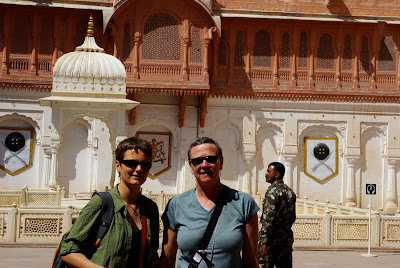
Entering the Karan Mahal courtyard, built in the Mughal style of architecture (the army there to protect us).
This lavishly decorated ceiling looks like a persian rug, but in gold lacquer ! This hallway leads to one of the Maharaja's many thrones (in the next picture).
This portion of the fort is the wives' apartments. Notice again how all of the windows are covered by the modesty screens.
This is part of the Badal Mahal (Cloud Palace). It is absolutely covered with the original vegetable dye paintings of clouds, yellow streaks of lightning and rain showers - a favorite fantasy in this arid land.
The Anup Mahal (The Hall of Private Audience) is sumptuously decorated. Every inch is covered with red and gold lacquer patterns and further embellished with mirrors and gold leaf. Another of the Maharaja's thrones is at the center.

Ceiling painting
The Maharaja liked to be amused and entertained by people sword walking and lying on a bed of nails (a display of faith and endurance). Here is what they used for that! OUCH!
Exterior walkway built in Italian Carrara Marble.
The Phool Mahal (Flower Palace) has painting that will blow your mind. The floral painting on every surface is so unbelievable! This palace contains the Maharaja's small, low bed with short silver legs, on which he slept with his feet touching the ground. The bed was so designed to enable the king to jump quickly to his feet and fight of murderous intruders. Mirrors are also strategically placed so that the Maharaja could see any intruder entering the room.
I love how the elephants are used as decoration throughout the fort.
Maharaja Rai Singh
This is what it looks like to look outside through the modesty screens. Its hard to imagine this is the view the women were given of the outside from their controlled viewing spots within the palace.
Marble tiled floor
Since this is a fort, there must be weapons. Here are some of the historical weapons used to slice and dice anyone silly enough to challenge the current ruler of the kingdom.
The ivory inlay work on these rifles is magnificent.
We found this DH-9 de Havilland plane in the museum at the fort. Here is the interesting history of how the WWI plane got here.

Now for some food entertainment!
We left the fort and were just famished after absorbing all of the art, history and culture. Our driver took us to an authentic Bikaner restaurant for lunch.
We started with this Dhokla (a bread like thing in sweet syrup with a kick-yo-ass side of green chilis! Weird but tasty...)
Yummy sweet Lassi to drink (yogurt based drink).
I ordered the Naan Tali - Shahi Paneer, mixed veg, Dal Makhani Pulao, Raita, Achar, Naan Roti, Missi Roti, Salad, Papad and a Sweet! All eaten with THIS..........
:o) HEAVEN!
We left the restaurant, bellies full, in the 97 degree heat to head off to see a camel breeding farm. That is coming next.............