July 5, 2012
Time for a brief historical tour of architecture and human history in Wales. Today we took a short trip out to St. Fagans National History Museum to have a look at some historical buildings, relocated here piece by piece, stone by stone, board by board, from locations all over the country. It's amazing to think that all of these historical structures were taken apart, stones/boards numbered and then put back together exactly as the original. St. Fagans opened in 1948 and has become the most visited heritage attraction in Wales. The museum shows how the people of Wales have lived, worked and spent their leisure time.
Kennixton Farmhouse - The oldest part of this farmhouse from the Gower peninsula (south coast) was built in 1610. The red color of the walls, and the berries of the rowan tree in the garden were thought to protect the house from evil spirits. But it could be that the color of the walls merely showed that the owners could afford to put pigment in the whitewash. The house is decorated as it would have been in the late 18th century.

 This is a stone pig house. The stones are stacked, without mortar, to create this structure. Pretty cool.


 Inside the houses there are replicas of everyday domestic items such as a loom, a cauldron and a grinding stone, and also weapons: spears, shields and a sword. A wood fire pit is in the center of the floor.


 I was especially interested in how all of the wood joinery in the church was done using wooden pegs. This is a photo from the beam work on the ceiling.


 Gwalia Stores - This grocery shop from Ogmore Vale was opened by William Llewelyn in 1880 and became known as "The Harrods of the Valleys". It finally closed in 1973. It is shown here as it was in the 1920's, with mahogany shelving and counters.
 This poster hung in the window of the store. We laughed as we thought about the young girls being pickled and bottled. Would there have been jars of pickled fingers and toes? :o)


 Here is the main room of the smithy shop. A really fantastic array of old metal tools, plough parts, iron tires for carts, candlesticks, door knockers, etc. Everything iron or metal that the smithy made.


A day well spent learning some history about the people of Wales.
A little bit more from South Wales in my next post and then we move on to North Wales.
Time for a brief historical tour of architecture and human history in Wales. Today we took a short trip out to St. Fagans National History Museum to have a look at some historical buildings, relocated here piece by piece, stone by stone, board by board, from locations all over the country. It's amazing to think that all of these historical structures were taken apart, stones/boards numbered and then put back together exactly as the original. St. Fagans opened in 1948 and has become the most visited heritage attraction in Wales. The museum shows how the people of Wales have lived, worked and spent their leisure time.
Kennixton Farmhouse - The oldest part of this farmhouse from the Gower peninsula (south coast) was built in 1610. The red color of the walls, and the berries of the rowan tree in the garden were thought to protect the house from evil spirits. But it could be that the color of the walls merely showed that the owners could afford to put pigment in the whitewash. The house is decorated as it would have been in the late 18th century.

Uncle Bob and dad (David)


You can tell here that Rowan takes after her father :o)

This is a working corn mill. The machinery in the mill is still powered by the water wheel.

The Celtic Village - This village is an archaeological experiment. Here is shown how people might have lived during the Iron Age, some 2000 years ago. The form of each house is based on archaeological evidence: the stone walled house from a hill fort near Conderton, Worcestershire; the largest house from a farmstead at Moel y Gerddi, Harlech, Gwynedd; and the smallest from Moel y Gaer hillfort, Rhosesmor, Flintshire. It all sounds very 'Lord of the Rings', and it is!
Evidence suggests that most people during this period lived in small settlements and farmsteads similar to this.

Check out the fabulous thatched roof.


An inside look at the roof structure

St. Teilo's Church - This church used to stand 50 miles from St. Fagans, near the river Llwchwr (can I buy a vowel please! :o), near Pontarddulais. It had served the community there for over 700 years. It ceased to be the parish church in 1850 and by 1973 was no longer a place of worship. Threatened by vandalism, subsidence and theft, it was decided to move the church to St. Fagans. As the building was taken down, a staggering discovery was made. Under layers of limewash, 500 year old wall paintings were found. This is why they have rebuilt the church as it may have looked in 1520, when it would have been Roman Catholic. Most worshippers then could not read and would have used the images to inspire meditation and prayer. The murals have been copied using medieval techniques.
The brightly painted wood screens are hand carved using traditional methods and designs and would have been found all over Europe in the middle ages. The church is named after Teilo, a 6th century Welsh saint and contemporary of St. David.


Here is one of the fabulous hand carved & painted wood screens


Taking a little rest from our history lesson


The Smithy - In 1868 Andrew Humphreys was the blacksmith at Llawr-y-glyn. At this time horses were a vital part of the rural economy. The bustling smithy was an important place for members of the community to meet.
My great-great grandfather was a blacksmith, so I was really interested in this smithy shop. It is very similar to the smithy barn he had (and is still standing with tools intact on the family's century farm in Kansas).
The first room you enter, called the pentice, is where horses were brought to be shod.


I want this vice in my own shop! A beautiful piece.

The floor in the shop is made out of simple stones. An example of using the materials you have around you.

A simple sheep barn made from stones that are at least a foot think. No wonder it is still standing after hundreds of years.

The happy black faced sheep peeking at me from inside :o)

St. Fagans Castle - The building has stood here since 1580, long before the museum was opened here. This is one of the finest Elizabethan manor houses in Wales. The castle belonged to the Earl of Plymouth and his family until 1946, when it was given to the museum.

The gardens around the castle

Esgair-moel Woollen Mill - Woollen mills like this used to be a common sight in rural Wales. Keeping sheep was the only type of farming suitable to the west Welsh hills. By the 1800's, making woollen goods had become an important industry in Wales. This mill was built in 1760. From 1880 until 1932 the mill produced blankets, shawls, flannel for making clothes and yarns for knitting socks. Local farmers would bring their fleeces to the mill to be turned into cloth or blankets for their families. At this mill, the raw, greasy wool had to be dyed, combed and spun before weaving. These processes are still carried out today in this same mill. It takes the museum weaver twenty hours of preparation and two hours of weaving to make a shawl.
The mill machines are powered by water and a water wheel.
Here is where the water enters the building. The water wheel is in the basement.

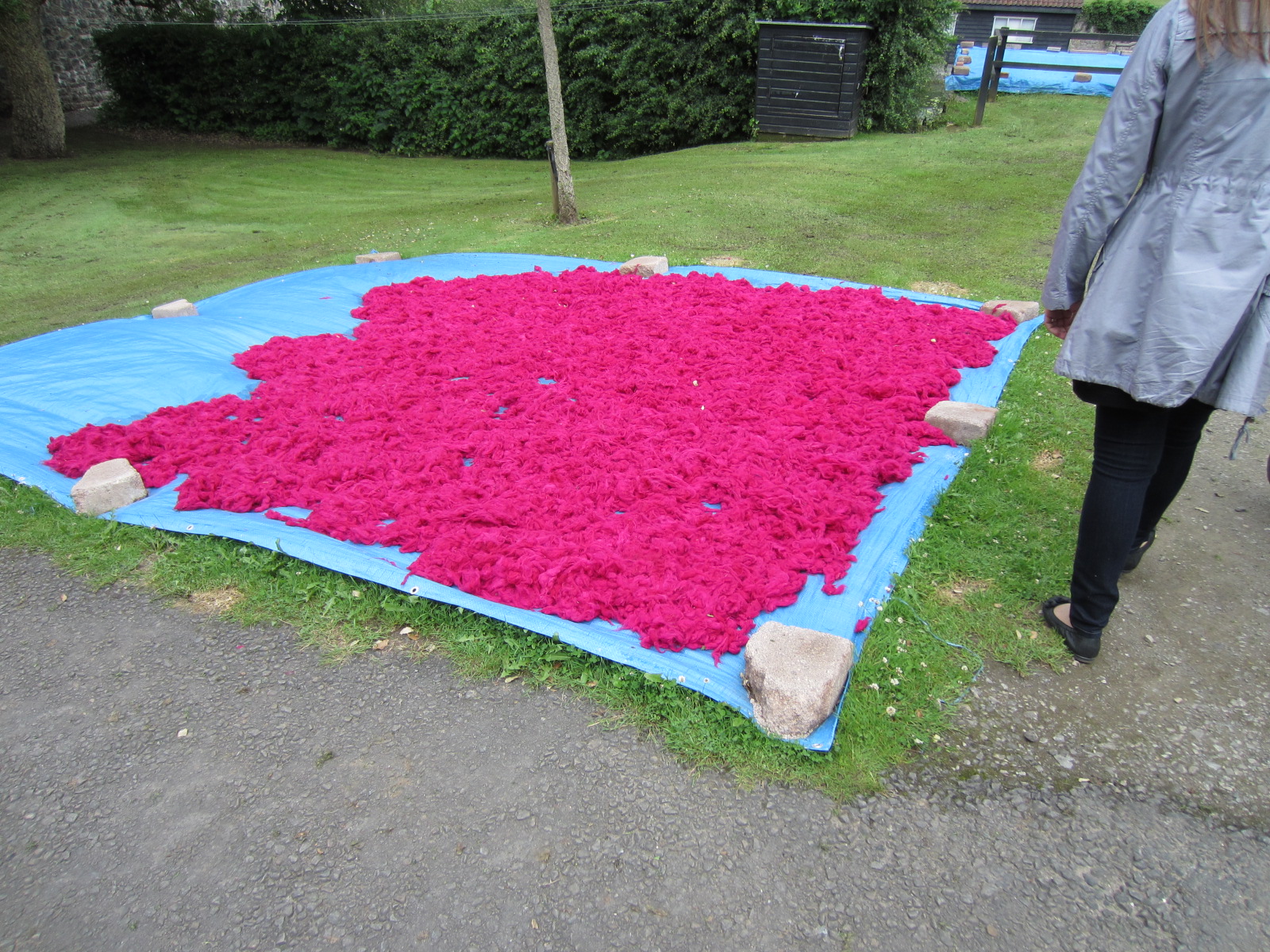
Dyed wool drying in the afternoon sun
The wool being processed into yarn

The hand looms that date from the mid 18th century. The looms themselves are amazing works of art.


A day well spent learning some history about the people of Wales.
A little bit more from South Wales in my next post and then we move on to North Wales.


