Monday, March 22, 2010

Bikaner & Junagarh Fort


March 11, 2010

The Camel Man Guesthouse will be our home here in Bikaner for the next two days. The guesthouse is located on the western edge of the town, which is in the middle of the Thar Desert. Vijay Singh (The Camel Man, who runs the camel safari business) and his wife are our hosts. They also live in the house and open up their dining room and living areas to the small number of guests they have here at one time.


The Patio

Our symbol of good luck, the trusty Gecko!

In the guesthouse dinning room. We also had a German and French couple and an Englishman staying at the house.


About Bikaner – The Camel City

Along with Jodhpur and Jaisalmer, Bikaner was one of the three great Desert Kingdoms of Rajasthan and, like them, prospered because of its strategic location on the overland caravan trade route in Central Asia and China. It is now the fourth largest city in Rajasthan. Rao Bika, the disgruntled younger son of Rao Jodha, the ruler of Jodhpur, founded it in 1486. Bikaner has many things to explore, with its old walled town where camels stroll past colorful shopping stalls, its many temples and palaces, and the magnificent Junagarh Fort, perhaps the best preserved and most ornately decorated of all the forts in Rajasthan. The only thing between Bikaner and Pakistan, less than 90 miles to the west, is the Thar Desert. Usta Art is the predominant art form. The floral and geometric patterned fabrics and jewelry, handmade rugs and vegetable dye paintings are exquisite.

Our day

We all sprang up from our morning nap and got our day organized. It was unanimous that we would see the fantastic Junagarh Fort first and then go on to visit a camel research farm ( the NRCC. I will explain later in its own post) and end the day with a visit to the Rat Temple (this one definitely needs its own post!).

Our driver from the guesthouse, Krpal, was another standout. He was extremely knowledgeable about every place he took us throughout the day. We arrived at the Junagarh Fort and began our incredible tour.

About the Fort

Constructed between 1587 and '93 by the third ruler of Bikaner, Rai Singh, Junagarh Fort is protected by a 3,235 ft. long sandstone wall with 37 bastions, a moat and, most effectively of all, by the forbidding expanse of the Thar Desert. No wonder the fort has never been conquered, a fact that explains its excellent state of preservation. This is one of the few major forts in Rajasthan that is not built on a hill. During Singh’s imperial service he traveled extensively, giving him an appreciation of art and architecture. These ideas have been incorporated meticulously into the style of the fort. Within the fort’s stone walls are no less than 37 profusely decorated palaces, temples and pavilions, built by its successive rulers over the centuries.

I will now post photos with captions, as this will be the easiest way for me to describe everything.
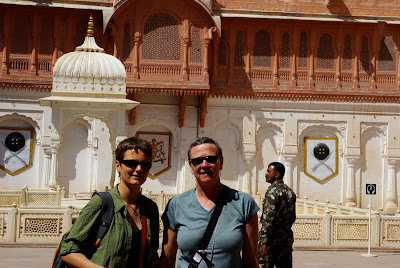
Entering the Karan Mahal courtyard, built in the Mughal style of architecture (the army there to protect us).

This lavishly decorated ceiling looks like a persian rug, but in gold lacquer ! This hallway leads to one of the Maharaja's many thrones (in the next picture).

This portion of the fort is the wives' apartments. Notice again how all of the windows are covered by the modesty screens.

This is part of the Badal Mahal (Cloud Palace). It is absolutely covered with the original vegetable dye paintings of clouds, yellow streaks of lightning and rain showers - a favorite fantasy in this arid land.

The Anup Mahal (The Hall of Private Audience) is sumptuously decorated. Every inch is covered with red and gold lacquer patterns and further embellished with mirrors and gold leaf. Another of the Maharaja's thrones is at the center.

Ceiling painting

The Maharaja liked to be amused and entertained by people sword walking and lying on a bed of nails (a display of faith and endurance). Here is what they used for that! OUCH!

Exterior walkway built in Italian Carrara Marble.

The Phool Mahal (Flower Palace) has painting that will blow your mind. The floral painting on every surface is so unbelievable! This palace contains the Maharaja's small, low bed with short silver legs, on which he slept with his feet touching the ground. The bed was so designed to enable the king to jump quickly to his feet and fight of murderous intruders. Mirrors are also strategically placed so that the Maharaja could see any intruder entering the room.

I love how the elephants are used as decoration throughout the fort.

Maharaja Rai Singh

This is what it looks like to look outside through the modesty screens. Its hard to imagine this is the view the women were given of the outside from their controlled viewing spots within the palace.

Marble tiled floor

Since this is a fort, there must be weapons. Here are some of the historical weapons used to slice and dice anyone silly enough to challenge the current ruler of the kingdom.

The ivory inlay work on these rifles is magnificent.


We found this DH-9 de Havilland plane in the museum at the fort. Here is the interesting history of how the WWI plane got here.


Now for some food entertainment!

We left the fort and were just famished after absorbing all of the art, history and culture. Our driver took us to an authentic Bikaner restaurant for lunch.

We started with this Dhokla (a bread like thing in sweet syrup with a kick-yo-ass side of green chilis! Weird but tasty...)

Yummy sweet Lassi to drink (yogurt based drink).

I ordered the Naan Tali - Shahi Paneer, mixed veg, Dal Makhani Pulao, Raita, Achar, Naan Roti, Missi Roti, Salad, Papad and a Sweet! All eaten with THIS..........

:o) HEAVEN!

We left the restaurant, bellies full, in the 97 degree heat to head off to see a camel breeding farm. That is coming next.............


Sunday, March 21, 2010

Train to Bikaner

9pm March 10, 2010

We have been waiting with great anticipation for our overnight train trip to Bikaner and the Thar Desert. This will be our first experience traveling on the Indian train system so we are excited to see what is in store for us.

Background on the Indian Train System

The Indian train system has tremendous ridership. It is the most effective and economical way to travel around the country. There are thousands of trains that run every day in every direction. Here are the classes you can choose to travel by:

Second Class (General Compartment) – you need no reservation for this class. You can buy tickets for this class at the counter at the station even when the train is standing at the platform ready to leave. Second class is the cheapest way to travel on the Indian railway system. For less than $10 US you can travel 2,000 miles. The only catch is there are no seat reservations, and no sleeping berths either, so you would have to sleep sitting up for two nights to travel that far. If you do get a seat, there is no guarantee you can hold onto it. You would have to keep your luggage, or any other personal object on the seat when you go to the toilet or walk around the train. An empty seat is open to anyone! You often see the poorest of Indian people traveling in these cars. We witnessed what was almost a riot as the second-class cars of another train were being loaded. The cars were being rushed by people trying to get on any way they could, through the windows and even running around on the tracks and between the cars to get in the back doors. It was CRAZY!

Second Class Sleeper Compartment – The sleeper class is the main chunk of a typical express train in India. You need a reservation to travel in this class. You have to bring your own bedroll also. Each compartment has seats for 6 that convert to sleeper berths at night. There is no AC in this class, so when it gets warm and stuffy, it can be hard to sleep.

AC 3-Tier Sleeper – This is the class we chose to travel by (thank god for the AC!). Our round trip ticket for the two eight-hour journies cost only $20 US each. Bedding and a towel are provided in this class. This class is widely used by the Indian middle class.

First Class AC – This is the highest luxury class in the railway system. The cost is roughly comparable with economy class airfare. The elite class of Indians and business executives travel in this class.

AC Chair Car – These cars are only attached to day-running trains. They look more like an economy-class seat on an airplane, although with a little wider seat. It costs slightly less than the AC 3-tier class.

Cargo Cars – Anything and everything goes here. Bags of mail, huge boxes and crates, goats (yes, we saw some walk by us on the platform), absolutely anything that needs to be moved from point A to point B.

Toilets – No glamour here. Put your feet on the stainless steel footrests and squat and leave it (right on the tracks!) :o) It's liberating! Bring your own TP too.


The Jaipur station was teaming with people, many of whom got here early and are sleeping on the floors, benches, etc. so they can get in line for a good spot in the 2nd class cars. Once we sorted out which platform we needed to get to, we started off in that general direction. Clean is not a way to describe this environment. The smell of human urine grew more intense the closer we got to the tracks......the toilets on the trains empty right onto the tracks, so of course if one goes to the toilet while the train is in the station, well, there you are! Not to mention that people feel free to relieve themselves on the tracks right in front of each other. The rats running around the tracks were also quite amusing, something to watch while we waited for our train.


Our train pulled into the station; we found our coach and proceeded to our berths.

We had the greatest time getting ready for bed and folding ourselves into origami-like shapes to get into our berths. It was hilarious! It was a nice feeling hearing others being gently rocked off to sleep by the movement of the train. For me, it was a hormonal night of sleeplessness listening to other people snore :o)

Rowan trying to start a tickle fight

Shrikant trying to start a pillow fight

Oops! Getting busted by the Traveling Ticket Examiner asking for 'our papers'.

Our train arrived in Bikaner at 4:50am and our driver was there waiting in the dark to pick us up. He took us right to our accommodation where we proceeded to take a nap before we started our day.


The adventure will continue............

More Jaipur


More from March 10, 2010

After our delicious lunch, our driver took us by a couple of other significant architectural sites. The Jal Mahal (Water Palace), was built by King Sawai Pratap Singh in 1799 in the midst of the Man Sagar Lake. The structure seems to rise from the lake like a mirage. He spent time there for pleasure and sometimes used it for royal duck-shooting parties.

We then made a stop at the Hawa Mahal – The Palace of the Winds. This was also built by King Sawai Prtatb Singh in the 18th century and is the most remarkably designed monument in Jaipur. It was designed to provide adequate vantage points behind stone-carved mesh-like screens for the palace women to watch royal processions passing through the bazaar.

In this close-up, you can see the carved mesh over the windows. How many wives did this guy have? Hmmmmmmm.....

The Hawa Mahal Bazaar surrounds the palace so we decided to do some shopping. What a fun experience! The variety of stunningly beautiful hand-crafted fabrics, jewelry, clothing, leather goods, etc. was a sight to be seen. We were in the market for scarves and sandals for our journey into the desert tomorrow, so that is what we concentrated on.

Here we are in a fabric shop looking for a scarf for Rowan. As you can see, the whole family is involved in the shop- dad in the background, the sons and their sons. They just keep bringing out more and more and more things for us to look at. It is important to them that they please us by finding something beautiful to buy from them. It was fun bartering with these guys.

This is one of our favorite pictures of Charanya. She is wearing the scarf that Rowan decided to purchase for $3 US (hand made!). Her dark brown eyes and asian skin along with that mysterious glance is just PERFECT! This is when we knew this scarf was the one.

We went on to look for sandals for Charanya and I. It was hilarious how the shoe guys would bring absolutely every pair of shoes from the shelves to find something that fit and pleased us. The entire floor was covered with shoes. Finding a size big enough for me, with my big American giant-sized foot was a challenge, but these guys did it (after trying at least 50 pairs!). I purchased a beautiful pair of hand made leather sandals for just $8 US.

I will end this post with another photo of a camel, just because I can't get over how cute and wonderful they are. It is really neat to see so many of them used for transportation here on the streets. A constant reminder that "we are definitely not in Kansas anymore". :o)


This one walked by us on the street and reminded us of someone we know :o) Here is the video.


We are off to Bikaner by train tonight. Stay tuned.......

Friday, March 19, 2010

Jaipur

March 10, 2010

Jaipur, also know as the Pink City because its prominent buildings are washed in this color, is the capital city of Rajasthan. It has a labyrinth of fascinating bazaars, lavish palaces and historic sites. Tradition and modernity exist side by side here. On the streets, motorbikes compete with cows, camels, elephants, donkeys, people and rickshaws for space. Turbaned village elders rub shoulders with young people in jeans. It is like taking a step back in time with a little twist of popular culture thrown in.

The rickshaws

Some architecture

Camel parking lot

Elephant taxi

A video of the street

We got up this morning and hired a driver to spend the day taking us to a few places we decided to explore. I was VERY excited that our taxi was going to be a 1957 Morris Oxford Series III Hindustan Ambassador. There are still many, many of these on the road here. Mostly used as taxi's.

The decision on what to see in our short time here wasn’t easy as there is soooo much history and culture to absorb. We chose to visit the Amber Palace and Fort complex first.


The Amber Fort is protected by Jaigarh Fort from the ridge above.


Short Amber Fort History: (sorry to bore you with more history, but it has always been my favorite subject, so you will always get some).

The Amber Fort lies about 10 miles northeast of Jaipur. The name “amber” derives from the goddess Amba Mata (Mother Earth) worshiped by local tribes at the site prior to the building of the fort complex.

Man Singh I established the fort palace in 1529 on the remains of an 11th century fort. Then, the Kachhawaha Rajputs (one of the three ruling warrior dynasties) maintained it as their capital until moving it to Jaipur in 1727. The Mughals (Pakistani Muslims) who were also in the region at this time had great influence with the Kachhawaha people; the pleasure palaces within the fort reflect the Islamic influence. Various other buildings were added to the fort by Jai Singh I between 1621-67 and constitute its magnificent centerpiece. The wall surrounding the fort encompasses the Old City, which was the early seat of the Amber kings before they made the fort their capital. Several havelis (private mansions) and temples can be seen below the fort, showing the existence of a self-sufficient township. As we were going through the fort, we decided the outstanding artistry displayed throughout the structure far surpasses any palace/fort we have seen anywhere else in the world. It is just magnificent! See what you think.

In this video we are walking up to the fort through part of the old town. Notice the open trench along the buildings to the left. This is how the waste water from the plumbing is removed from the houses. It makes for a very aromatic walk through the streets. This situation is still found in parts of many cities in India.


View of the Old City as we climbed to The Fort. Notice the fort's wall running up along the ridge and down the side of the mountain.

Here is a video of our very handsome guide (I'm a sucker for a good looking Indian man). He stayed with us throughout our time at The Fort and in the Old City.


As we passed through the main entrance of the fort we entered the main courtyard, also called Jaleb Chowk. As you will see, my people are always waiting for me as I am the one who is always taking the pictures :o)


Part of the Temple of Goddess Shilla. The outstanding decorative painting on this temple was done over 400 years ago with paint made from vegetable dyes.

We found it amazing how well these two antiquities have been preserved :o)

The magnificent Ganesh Pol is the shimmering three-storied gateway to three pleasure palaces, built in 1640, it is connected to the private apartments of the many wives by the screened uppermost level, meant for ladies in purdab (dress as a form of coverage).

Here is Ganesh in all of his splendor

The exquisite painting on this structure is simply stunning, again done with vegetable dye paint. The architectural attention to detail blows your mind.


Here are the hand carved marble modesty screens on the upper level used by the ladies to look out over the square. Apparently the women's apartments on this level have been designed in a manner which could easily facilitate the entry of the maharajah to various chambers without any of the concubines aware of the visit to any room!


The Sheesh Mahal and Jas Mandir. The walls and ceilings are inlaid with tiny mirrors and colored glass. It's just CRAZY how detailed everything is.


Exquisite floral marble carvings trimmed in black onyx inlay


These huge pots were used to cook food for the fort, routinely 700 people. We'd like to see what kind of spoon they stirred these with!

Now, here is the highlight of our day. As we were exiting the fort, we came upon a couple of snake charmers. Yes, real snake charmers. This was one of the things on our wish list that we wanted to see while here in India. We can't believe we actually found one!


Rowan asked if she could try to play that odd stringed instrument the guy on the left was playing. She had a very funny go at it (Personally, I'd say 'terrible' go at it! R).
Our cobra friend

We left the palace and walked back down through the old city to go check out the local artist bazaar. There was no photography allowed inside the market, so there are no pictures of us shopping. They did let me take one photo of Shrikant & Charanya in the Rajasthani turban's because it was so cute. You all will just have to visit us when we get home so you can see the fabulous things we bought while we were there. :o)

Check out the FABULOUS elephant tapestry behind the sheiks

After our shopping spree we were famished so our driver took us to a local Rajasthani restaurant to get some lunch. The food was outstanding. The beer cooled our very hot heads. The naan to die for!


I think I'm going to make a bed out of naan when I get home, all slathered in ghee.
The comfort food of the gods! I just can't get enough of it! YUM!

More to come..................